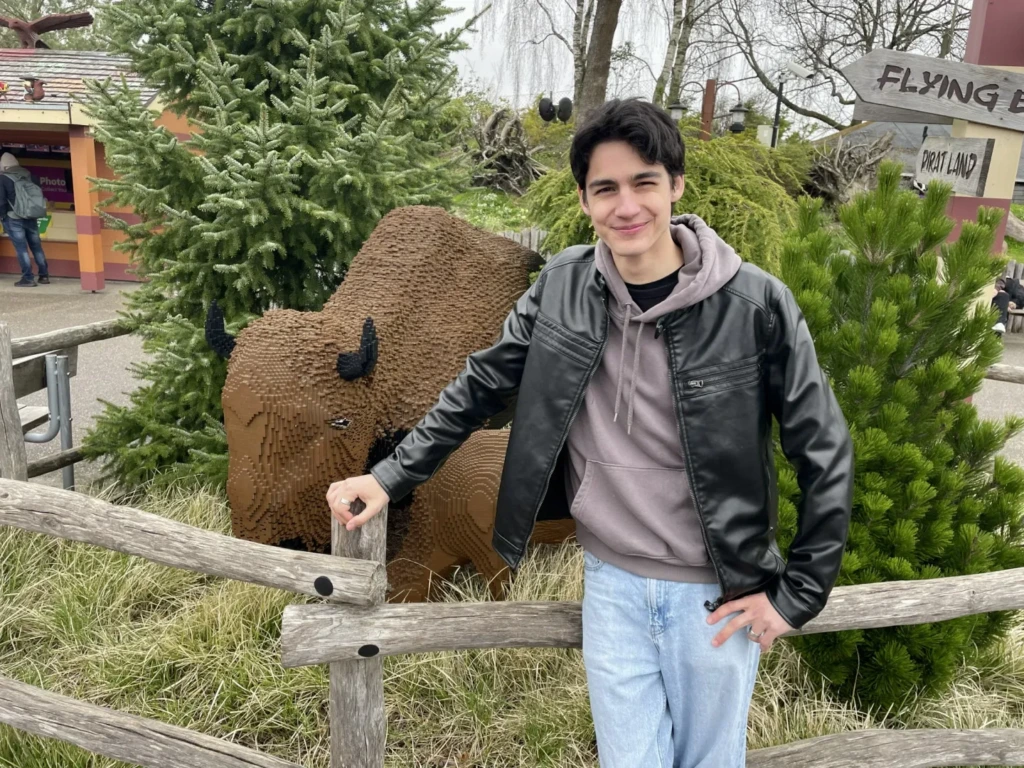
Advanced bionic prostheses can cost tens of thousands of euros, putting them beyond the reach of many people. Daniel, an engineering student from Hungary, wants to show that the future could look different. While studying at Kaunas University of Technology (KTU), he developed a prototype bionic hand that responds to electrical signals generated by human muscles. “My goal is a non-invasive, affordable prosthesis that anyone could buy off the shelf, just like a pair of glasses,” he says.
Daniel Papp, 21, studies mechatronics at the Budapest University of Technology and Economics (BME) and has a keen interest in robotics, electronics and biology. Yet the bionic hand project he developed at KTU’s YOUNG Lab prototyping lab for early-career researchers is more than an opportunity to put his technical knowledge to the test.
“For most people without adequate health insurance, they are simply unaffordable. I want this technology to be accessible to as many people as possible, with prostheses available to buy in an ordinary shop,” says Papp.
Special Sensors Attached to the Body
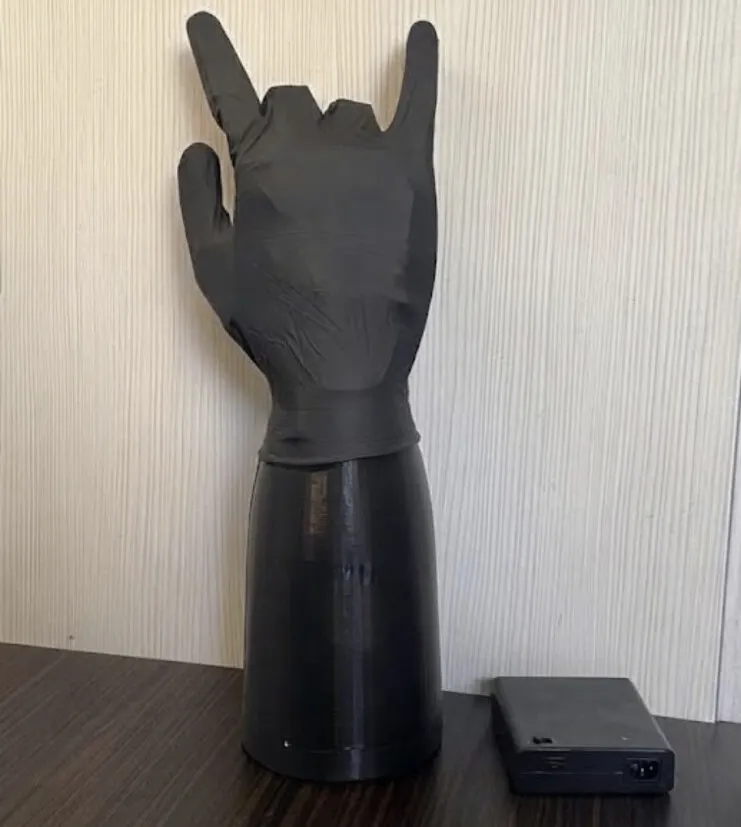
Daniel’s first version of the bionic hand was designed purely for testing and worked on a simple principle: flex sensors mounted on a special glove detected movements of the wearer’s hand. Each sensor controlled a corresponding finger on the 3D-printed hand.
But he did not stop there. In the second version, he improved the hand’s design and motors, replacing the flex sensors with electromyography (EMG) muscle sensors.
“This meant I no longer needed a special glove fitted with sensors. All I needed were electrodes attached to my hand and new code to detect muscle contractions,” explains Papp.
Can Grip Around 5 Kilograms
Behind every working prototype lie countless hours of testing, setbacks and problem-solving. For Daniel, one of the most memorable moments was relatively simple, but particularly meaningful.
“It was when I finally assembled all the components, uploaded the basic code and saw the hand begin to move. I had spent countless hours on the project, working until 10 pm. I felt enormous relief and excitement when everything worked on the first attempt,” recalls Papp.
The project has now reached technology readiness level 4 (TRL 4), meaning that its key components have been validated in laboratory conditions. The bionic hand can move each finger independently, although the wrist remains fixed.
“Compared with earlier versions, the hand looks more realistic, is easier to 3D-print and requires less post-processing,” says Papp.
Improvements to the motors and the cable system that moves the fingers have also increased its gripping capacity to approximately 5 kg. The developer acknowledges that this is still considerably less than the grip strength of a human hand.
“One of the biggest technical challenges at the moment is the size of the servo motors and how to integrate them into the prosthesis without leaving them visible,” says Papp.
Potential Applications Beyond Prosthetics
Daniel believes that as technology advances and 3D printing becomes increasingly widespread, his solution could have considerable potential in the future.
“Thanks to KTU, I gained access to laboratory facilities where I could use advanced rapid-prototyping equipment and machines I had never worked with before. Whenever I encountered technical challenges, the laboratory staff and mentors were always ready to help and advise me on how to overcome them,” says Papp. “On a personal level, this international experience reaffirmed my passion for engineering and how much I enjoy developing and delivering projects from scratch.”
What could you make at KTU? Chat with our students about life at the university, from classes to hands-on projects in the lab.